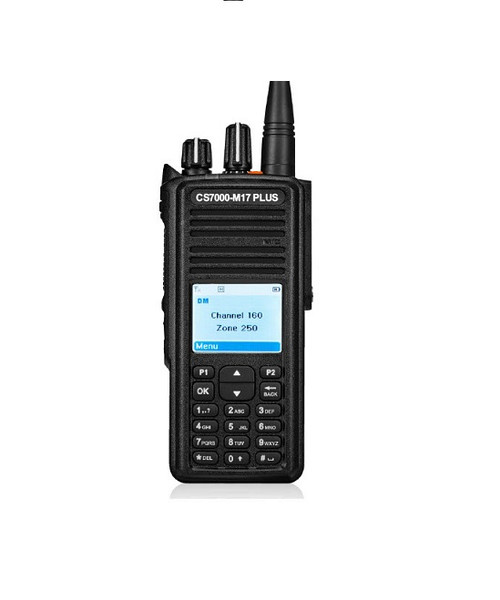

 m
m



You've probably seen companies like Rapid Radios pushing sleek little handhelds that run on Wi-Fi, POC, or LTE. They're impressive — until the moment you actually need them. Every one of those technologies depends on a fragile chain of cell towers, fiber-optic cables, and remote servers scattered across the globe. LTE, 4G, and 5G hand your voice off to a local tower, race it through hidden cables, and pass it to another tower before it ever reaches the person on the other end. POC radios lean on a single server that may sit in another country entirely. Wi-Fi radios? They're nothing without the internet.
What do all of these modes have in common? Every single one of them lives or dies by two things: electricity and a working server somewhere humming away in a data center. Cut the power, and the whole house of cards collapses in minutes.
And the power will fail. That's exactly why you became a prepper in the first place. There are a handful of scenarios where it happens, and the most obvious — the one that's practically guaranteed — is severe weather. A single tornado, hurricane, or flood is all it takes to knock out the cell sites and internet nodes your communication depends on.
The second scenario is far less random: deliberate sabotage from within. If you wanted to bring a nation to its knees overnight, what would you hit first? The power grid. Most outages can be patched up within hours — but with a little planning and the right knowledge, a small group could keep the lights off for weeks.
The third — and most chilling — scenario is a deliberate attack on our power grid by a hostile foreign nation. What do you think the odds really are that Iran, Russia, or China can already hack their way into our grid and bring it down? In all likelihood, they've had that capability for years. They're not waiting for permission — they're waiting for the right moment.
The bottom line is simple: when disaster strikes — natural or man-made — radios that depend on Wi-Fi, POC, or LTE will fail. And as a prepper, "failure" is not an option. You need a way to reach your family, your neighbors, and your community when the SHTF — and you need it before the grid goes dark, not after.
Problem with Existing Radio
Plenty of radios will keep working when the internet and power are gone — GMRS radios, for example, do exactly that. But they come with a hidden catch: every one of them has to be preprogrammed in advance to work in an unknown environment. Guess wrong, and you've got an expensive paperweight. That's the problem we set out to solve. We built a radio specifically for the prepper community — one that can find people you didn't know were out there and keep you connected to your family on the channels you already trust.
Solution
The solution is as old as radio itself: pure, direct radio communication — no internet, no servers, no middlemen. You've probably seen it in action. When natural disasters hit major cities, it's often the amateur radio community that steps in to keep emergency communications alive, while the city's own multi-million-dollar systems — the ones built on cell towers, repeaters, and fiber — buckle under the very disaster they were supposed to handle.
The amateur radio community runs on equipment like ours — radios that transmit signal-to-signal, with no internet in the loop. They've got the infrastructure already in place to back up Public Safety in an emergency, and they've trained for the worst-case scenario for decades. But what happens to you — the prepper who hasn't been licensed for thirty years, or whose situation falls completely outside the textbook? That's exactly where this radio shines.
Of course, you can set this radio up to talk straight to another radio — no internet, no repeaters, no middle layer of any kind. That works beautifully if the person on the other end has matched their radio to yours ahead of time. But what if you couldn't plan in advance? What if the plan you did make no longer matches the world you're standing in?
What Else do I Need
But what happens when you need to talk to someone you don't even know is out there — or use a repeater you didn't know existed? That's where this radio leaves every other handheld in the dust. The CS7000 M17 PLUS hunts down nearby radios and repeaters on its own, and configures itself to match whatever it finds — automatically.
Do I need Military Grade Encryption
When the SHTF, some conversations are nobody else's business. The CS7000 M17 PLUS gives you 256-bit AES encryption — the same standard trusted by the U.S. military and major financial institutions — along with several lighter encryption modes for everyday use. (Note: encryption is prohibited on the amateur bands, but it's perfectly legal everywhere else).
I Am Lost! Now What?
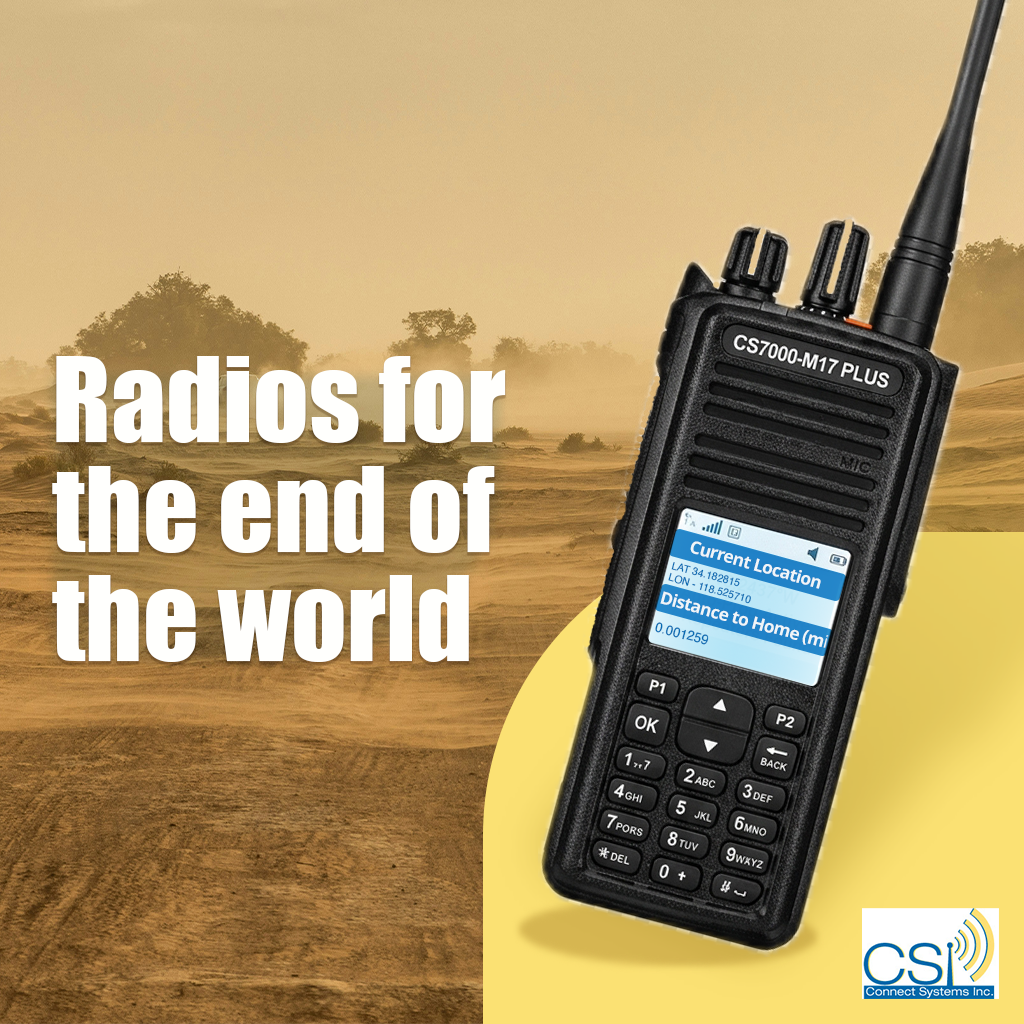
Sometimes circumstances force you to move fast — to a place you've never been, with people you need to find. The CS7000 M17 PLUS solves that with a built-in "GPS Location" mode that works three ways. First, your screen shows your exact GPS coordinates, so you can read them off to a family member and let them come to you (or send someone else). Second, when someone gives you their coordinates, the screen guides you straight to them. Third, if you've wandered off and need to get back, the screen tells you whether you're getting closer or farther — and exactly how far away that spot is right now.
I need Help! Who can I speak to?
You've just landed somewhere brand new — a place where you don't know a soul. The CS7000 M17 PLUS solves that with a feature called "Enhanced Scanning." Tell the radio to sweep between any two frequencies, and it quietly listens to every conversation happening in between. When it finds traffic, it captures the details. Once you've collected enough channels, two button presses save the whole batch — and you can call back on any one of them. For the ham community, it's also one of the fastest ways to discover which repeaters in your area are actually active.
I Can’t Wait, I want to speak to Someone Now
The CS7000 M17 PLUS has a feature called "GPS Roaming" — and it might be the closest thing to magic in any handheld on the market. Built into the radio is a database of every known amateur repeater in the world. Combine that with the radio's onboard GPS, and the moment you turn it on, it knows where you are and instantly loads the 64 closest repeaters. No programming. No cables. No guesswork. Just turn it on and start talking.
I found an Interesting Channel, Who Else Is on It?
On a busy channel, every user often has their own signature — a unique CTCSS or DCS code on analog, or a unique contact code on digital. The CS7000 M17 PLUS turns that maze into a map with a feature called "Channel Analyzer." Park on any channel, and the radio quietly records every distinct user it hears. Once it's gathered enough, two button presses and the radio programs itself to reach each of them — automatically.
Someone is Speaking, and I want to speak To Them Now!
The CS7000 M17 PLUS has a special feature called "Enhanced Monitor" — and it does something no other radio on the market can do. Park on a channel, wait for someone to start talking, and while they're still speaking, press a few buttons. The radio instantly analyzes the incoming signal, builds a matching channel on the fly, and hands you the microphone — ready to answer right back.
Can I Create a New Channel or Edit an Existing Channel?
With the CS7000 M17 PLUS, you can build a brand-new channel or edit an existing one right from the keypad — no computer, no cable, no software required. A single, simple keyboard sequence handles it all. No more juggling a different key combo for every parameter. We call it "Enhanced Edit."